“It’s tough to make predictions, especially about the future.”
~ Yogi Berra (1925-2015, professional baseball player)
-
- Global markets are closing out strong in 2025, shaking off the pervasive uncertainty experienced throughout the year.
- Corporate profits, centered around the insatiable demand for Artificial Intelligence (“AI”) has led to a boom in corporate spending.
- The consumer remains resilient despite years of increasing prices, and spending has sustained the economic growth picture, for now.
As always, time rolls on, and in just a few weeks, the calendar will turn to a new year, new resolutions, and new predictions. But in general, people overestimate their abilities to predict accurately; there are no time machines to help. Interestingly, the term “Time Machine” was first popularized by H.G. Wells in his 1895 novel of the same name, though references to time travel date back even further. And there is some evidence from Ancient Mesopotamia about 4,000 years ago indicating astrology was used to forecast what may lay ahead.
Today, predictions are a way of life. Entire industries, such as sports gambling, have emerged around the concept of predicting the future. Global markets operate on a similar principle; attempting to predict economic growth and corporate performance, then assigning values based on seemingly countless data points, all rooted in expectations about the future.
Reasonable predictions require an infinite number of inputs to create. For example, the winner of the college football playoff is not only determined by which team has the best players (“best” being a subjective term in itself), but also by where the games are held, coaching skills, fan turnout, travel schedules, pre-game hotel and sleep conditions, individual diets, etc. The more data applied, the better those predictions become. The stock market is similar: Even if growth predictions about the broad economic direction and the interest rate environment are exactly right, suppose many other investors also “predicted” correctly. Many investors expecting a certain outcome will proactively capture mis-pricings. If they do, it is possible that the prediction may have at least partially played out since many had similar expectations.
In other words, predictions are complicated and not for the faint of heart. We won’t call the following list our predictions for 2026, rather “what we expect to be the drivers for 2026 performance.” Our “expectations” could be a small sample of what drives markets, and accordingly portfolio management. Without further ado, we present our 2026 list of metrics to watch:
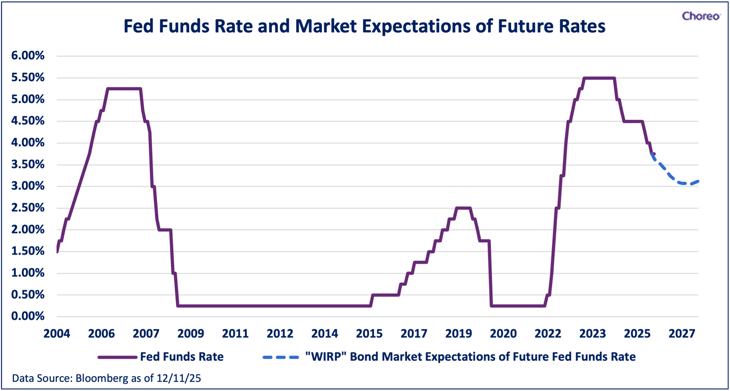
1. Interest rates: Interest rates are a mundane but essential topic that global markets focus on acutely, particularly in times of uncertainty. Lower rates generally mean less expensive capital for companies to fund projects and hire employees, and for individuals financing purchases (i.e., houses, cars, etc.). Current expectations are shown in the graph below, with the market expecting the Federal Reserve (the “Fed”) to cut rates by 0.25% - 0.50% to settle in the low 3% range in 2026. In general, the Fed only has a degree of control over short-term interest rates, whereas longer term rates are often influenced by a host of separate factors. In truth, however, even short-term interest rates are subject to market forces, dictated by how investors expect the future to unfold. Regardless, the direction of interest rates is a critical input to watch in 2026.
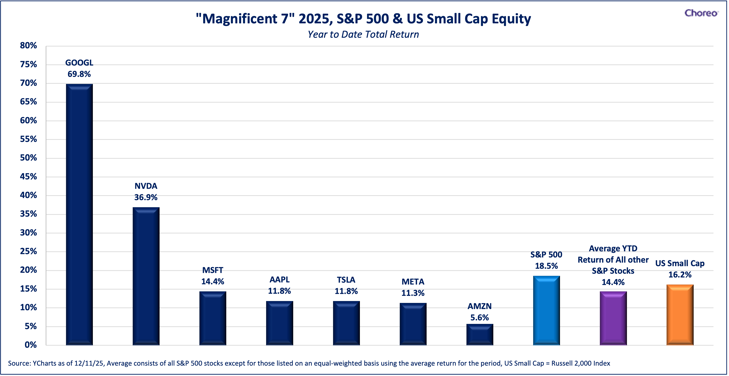
2. Stock market Breadth: It may sound like a broken record to suggest the markets have once again been dominated by a handful of (mostly) technology-focused companies, but that has indeed been the case for most of 2025. The AI play has boosted the mega-caps (such as Nvidia) along with a growing number of smaller speculative companies. In 2026, markets will be paying attention to broader market performance among small cap indices, which until very recently had experienced dramatic underperformance, as shown in the graph below. More recently this trend may have begun to reverse as smaller businesses and a broader array of companies have experienced stronger performance in the fourth quarter.
3. Economic Conditions, namely labor markets and inflation: Broadly speaking, the economy held up far better than many expected in 2025. The labor market has slowly weakened from the tight, overstretched conditions in 2023-2024, but sits comfortably around the Fed’s desired targets. Economic growth has continued generally on pace as measured by GDP and inflation has cooled, although not quite to desired target levels. There is some concern that inflation could be headed higher based on several factors, such as tariffs. Investors will be closely monitoring for changes in 2026 and beyond.
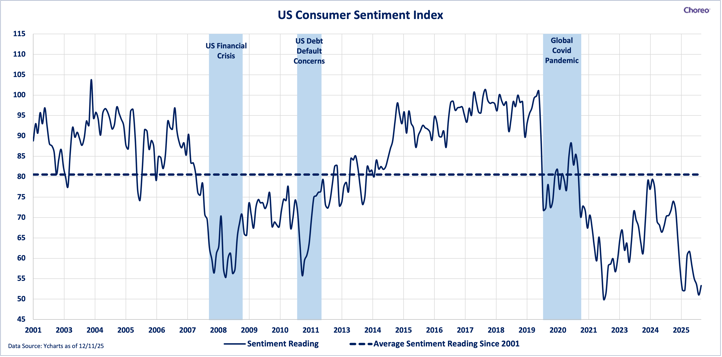
4. Consumer strength: Consumer spending in the U.S. is the predominant economic force. This spending has remained strong in a wide variety of periods (including during the COVID pandemic-led recession). Signs of weakness for consumers have emerged, albeit inconsistently across demographic segments, with lower-income households beginning to feel inflationary pressures while higher-income households have generally shown continued strength. Consumer sentiment has been reflective of these challenges and remains depressed as shown in the chart below. Change for the consumer and their spending habits could have profound implications for the broader economy, making it a high priority item to watch in 2026.
5. Technology development: Developments on the technology front have driven many booms in U.S. history, although these rapid technological advancements are certainly not without new risks. Dating back to the industrial revolution, assembly lines, the internet boom and eventual bubble, etc., tech advances usher in new jobs, new ways of life, new efficiencies and new investment opportunities. At the same time, there are meaningful risks of technology, not just in terms of use cases but also as related to potential job losses and economic disruption. The ongoing enablement of AI in many parts of our society will undoubtedly have significant impacts, and 2026 looks to be a pivotal year for both the technologies as well as the markets as it relates to the AI investment thesis.
Other Notables:
1. Midterm elections: Generally speaking, elections (whether presidential or mid-term cycles) tend not to have longer term impacts on markets. Regardless, starting this summer American lives will once again be inundated with political sparring, and the financial world will begin the onslaught of graphs and data suggesting markets do better under various political conditions. Policy impacts could result from the elections, although these typically play out over much longer periods. Nonetheless, this is one worth watching (and it will be hard not to watch if history is any guide).
2. Geopolitics: Similarly, geopolitics (a combination of geography and political relations) tend to have negligible effects on markets, although short term volatility can be pronounced. Indeed, there are a few “hotspots” around the globe – from the obvious like Ukraine to the indirect conflicts like China trade, and to new ones like Venezuela. All of these are worth monitoring because they can be highly disruptive. Geopolitics has entered new realms with a more intense battle for supremacy of technology and heightened competition for resources. 2026 will likely yield some solutions and some new conflicts, the scale of which could determine market impacts.
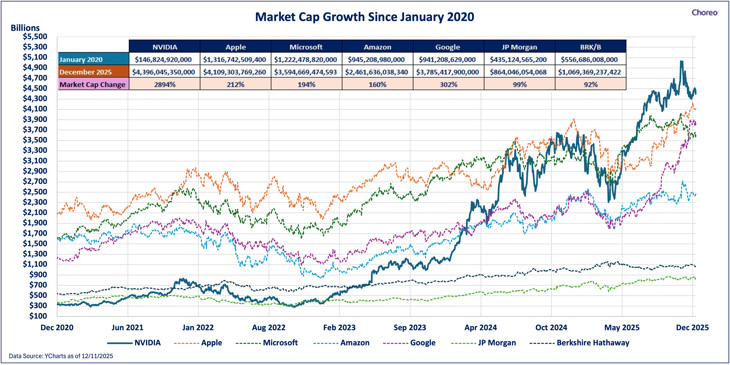
3. Nvidia (and the other 6): In January of 2020 amidst the COVID pandemic, Nvidia had a market capitalization of $150 billion. Very few outside of the technology or investment landscape had even heard of the company. Today, companies valued around $150 billion include Capital One, Boeing, Pfizer and Adobe, generally considered household names. As of December 9, 2025, Nvidia has a market capitalization of $4.5 trillion and is the largest publicly listed company in the world. It has led a group of large companies affectionately known as the Magnificent 7 (“mag 7”), including Alphabet (the parent company of Google), Apple, Microsoft, Meta (the parent company of Facebook and Instagram), and Tesla. Nvidia didn’t exactly come out of nowhere, but its semiconductor chips have now become essential to the ongoing AI boom. As of the end of November, these companies represent roughly 35% of the S&P 500. Naturally, how they perform can impact broader market returns. Nvidia alone accounts for just under 8% of the index. In other words, if these companies continue to grow and do well, markets could react favorably, and vice versa. Their size alone (in excess of $1 trillion, which was believed to be an almost unattainable benchmark not too long ago) makes them worth attention in 2026.
4. Liquidity: The frequently overlooked feature of market performance is liquidity and its accessibility. History has shown that more available liquidity, often in the form of loans, has driven a stronger economic cycle. However, if liquidity standards become too easy, and too much debt is offered (we saw this leading up to the 2007-2009 great financial crisis), default rates will pick up and economic declines can occur. Closely monitoring the availability of credit, credit standards, and eventually defaults can help guide economic cycles. Various other metrics suggest that 2026 could be a pivotal year in terms of liquidity metrics worth watching.
This list is by no means exhaustive and there are many other important items to monitor. There are endless data points that may cause markets to react, sometimes even violently. Heading into 2026, these guideposts can help investors remain anchored to the long-term.
CONCLUSION
The Choreo team is hyper-focused on long-term investment management to closely align investor goals and objectives. The market environment will change over time, whether good or bad. Taking a diversified approach is a tool used to optimize outcomes. As 2025 comes to a close and 2026 begins, we take a moment to recognize the most important asset class in our lives: our friends, our families, and of course our clients. We wish you and your family a happy and healthy new year and we look forward to a fruitful 2026! As always, please reach out with any questions or comments.
Disclosures
The performance numbers displayed herein may have been adversely or favorably impacted by events and economic conditions that will not prevail in the future. Past performance does not indicate future results and investors may experience a loss. The indices discussed are unmanaged and do not incur management fees, transaction costs or other expenses associated with investable products. It is not possible to directly invest in an index.
Opinions are expressed as of the date indicated, are subject to change and are based on sources considered reasonable by Choreo.